Showing posts with label gerry adams. Show all posts

01 July 2009

GAZA REPORT RELEASED


Published by Irish4Palestine Writers Group

“Peace making is conducted by and between enemies not between friends.”

Sinn Fein's President,Gerry Adams, has finished his report on the Gaza situation and Middle East peace process. This report will be forwarded to the US government, through George Mitchell and Tony Blair. I had this emailed to me two days ago, but only checked email today, sorry for the small delay in posting it. I will publish important excerpts of the 36 page report made by Adams in this post. For those interested in reading the entire document a PDF link will be at the end of this post. Please note, this is a very long but important post which addresses the political aspects of conflict resolution along with an assessment of the situation.
QUOTE “Several Palestinians, supporters of the peace process route, mature in both age and political experience told me that they feel as angry now as they did when they were teenagers. They find, in themselves and their contemporaries, a hardening of attitudes.”

“Others voice the opinion that generations coming up, unless there is a peace settlement, will make Al Qaeda, in retrospect, look like moderates.”
Sinn Fein President Gerry Adams MP MLA today launched his report ‘Israel, the Gaza Strip and the West Bank, April 2009 – A Report’.

Another start must be made in the Middle East. That includes a huge international effort to begin the work of reconstruction in the Gaza strip and the West Bank.

The international community also has a duty to create the political conditions in which a real dialogue can happen.

So far it has behaved in a shameful way by failing to effectively and persistently pursue the building of a peace process capable of delivering a political settlement.

That must change.

The Sinn Féin peace strategy helped create the conditions for the Irish peace process which has transformed political conditions in Ireland. While no two conflicts are the same there are nonetheless broad principles which can be helpful in all conflict resolution processes.

Sinn Féin, within our limited resources, is willing to offer our experience to others if it can help.

Is mise
Gerry Adams MP MLA
Sinn Fein President
June 2009 Israel, Gaza and the West Bank - A Report:
Destruction caused by Israeli Operation Cast Lead.

Report follows image map of destruction.
CLICK IMAGE TO VIEW LARGE SIZE


_ Approximately 3,500 homes destroyed, 28,000 homes damaged.3

_ 800 industries damaged/destroyed during Operation Cast Lead: 120 million USD of directphysical damage incurred during the 22 day military operation.4

_ Agricultural sector: Direct losses to crops, fisheries, livestock and poultry estimated at $180 million.

_ Impact on the infrastructure of a future Palestinian state: Palestinian Legislative Council destroyed; 7 government institutions completely or partially destroyed.

_ 10 schools destroyed, 204 damaged.5

_ 600,000 tonnes of rubble need to be removed.

_ 14 mosques destroyed, 38 mosques, 2 churches and the British Commonwealth cemetery in Gaza damaged.

_ 41 public health clinics and 29 ambulances were either damaged or destroyed.6

_ Prior to the IDF operation, per capita water consumption was 80 litres/person/day, below acceptable international standards (minimum guidelines 150 l/person/day). During
Operation Cast Lead, 11 water wells were either partially damaged or totally destroyed, 4 water reservoirs were damaged, 20,000 meters of pipes, 4 sewage network and pumping stations and one of Gaza's two main sewage treatment plants was damaged.

_ 57 km of asphalted roads destroyed, resulting in $78 million of physical damage.

SETTLEMENTS


In its report: Israel and Palestine an Irish Congress of Trade Unions delegation visited the Middle East in November 2007.In its Overall Conclusions it describes the impact of the settlements and of the Separation Wall.

The Settlements
The settlements - which violate international law - and the Israeli checkpoints are all pervasive.

Everywhere we went in the West Bank we observed settlements, some of them massive, most often located on hilltops, overlooking and monitoring the Palestinians below.

The settler accommodation invariably comprised bright, modern houses and apartments and is in stark contrast to the impoverished shanty town appearance of the Palestinian homes below.

The settlers themselves are heavily armed and are protected throughout the West Bank by a strong Israeli military presence. Indeed, mobility within the West Bank between Palestinian villages, towns and cities is severely curtailed and under the control of Israeli forces: for example, entering and leaving Hebron or Nablus.

The Israeli army, as well as armed Israeli civilians, operate barriers and controlled crossings, many of which resemble the heavily fortified border checkpoints which were evident during the conflict in Northern Ireland.

Also very noticeable is the fragmented and divided nature of the West Bank itself, which is due to the proliferation of 'settler-only' roads controlled entirely by the IDF. Many are newly constructed, of high quality and frequently run in parallel to existing roads used by Palestinians. These roads provide direct access for settlers to urban areas which Palestinians are prohibited from entering (e.g. Jerusalem), or which Palestinians can only enter after long detours - often taking several hours - and after processing at Israeli checkpoints.

There is little doubt that this two-tier infrastructure both hampers and impedes any form of sustainable Palestinian development and prevents the emergence of a viable, contiguous, independent Palestinian state.

The Separation Wall


The delegation saw multiple examples of the devastating impact the construction of this massive 9 metre high concrete wall is having (Irish company Cement Roadstone Holdings (CRH) owns a 25 percent share in Mashav, Israel's only cement company, which supplies construction materials for the wall). (Irish people see my note at end of post)

It dominates huge swathes of the Palestinian landscape, destroying agricultural land, cutting farmers off from their livelihoods and causing the destruction of tens of thousands of olive trees.

It was genuinely shocking to see the impact of the wall in urban areas, where it sunders entire communities and neighbourhoods, and imposes severe restrictions on access to essential services and employment. The delegation heard, but was neither impressed nor convinced by the argument that the wall is essential to the security of Israel.

It was noted that the wall does not follow the route of the 1967 Green Line border. It has instead snaked into Palestinian territory and seized up to 12 percent of Palestinian land, including significant water resources.

The delegation believes, therefore, that the construction of the wall amounts to a land (and water) grab, while simultaneously creating a new border in advance of any possible final settlement.

In July 2004 the International Court of Justice, in The Hague, declared the construction of the wall to be illegal, ordered that it be dismantled, and ruled that Israel should pay reparation to the Palestinians affected by its construction. The ruling also found that the wall, in conjunction with other Israeli measures, "severely impeded the exercise by the Palestinian people of its right to self determination."

The Gaza Strip:


From the moment you enter the Gaza strip under the gaze of the watchtowers and through the huge gates in the security wall and security system controlled by Israel at the Erez Crossing, the overwhelming sense is one of entering a huge open air prison. A million and a half people live there enduring multiple deprivations and denial of rights.

The television images of the assault on Gaza by the Israeli Defence Forces (IDF) and the cold statistics set out in multiple reports from reputable international relief and human rights agencies all support claims that society in general on the Gaza strip was the target of this assault.

Residential areas, educational and medical facilities alongside political and civil administration establishments were targeted. This included the police. Water and electricity services and roads were also targeted. Military institutions were attacked.


The human cost of the assault on Gaza is an affront to humanity.The reason given for the assault is that it was a reaction to the firing of Qassam rockets.

"No-one in Gaza believes this."

Moreover, by any standards, it was a wholly disproportionate response.

A UN panel, led by Ian Martin a former head of Amnesty International concluded that Israeli actions in using white phosphorous munitions showed a 'reckless disregard' for human life.

Those Palestinians I spoke to believe that the assault on Gaza was an attempt to topple Hamas and to demonstrate to the people of Gaza the price for voting for that party.

There will be no Palestinian/Israeli agreement without an agreement on Jerusalem. This is a universal view amongst the Palestinian opinions shared with me.

West Bank Palestinians are subjected to stop and search on a daily basis and often several times a day at some 600 permanent roadblocks and crossing gates set up by the Israeli Defence Forces in the West Bank.

Alongside this seven hundred kilometres of roads have been constructed for the exclusive use of the Israeli Defence Forces and Israeli settlers in the ever burgeoning programme of colonizing Palestinian lands through the establishment of new Israeli settlements.

All of this, like the grotesque Separation Wall which stretches for 662.8 kilometres and snakes its way across Palestinian land is done in the name of security. All are illegal.

“Wall and planned settlement expansion will place 45.5% of the occupied west Bank under Israeli control … the revised Wall route alone de facto annexes 9% of the west Bank … effectively incorporates over 370,000 illegal settlers or nearly 87% of the Israeli settler population…Israel claims the Wall is about security, but the revised route, which stretches 662.8 km, still runs more than twice the length of the 1967 border …”

"Several Palestinians, supporters of the peace process route, mature in both age and political experience told me that they feel as angry now as they did when they were teenagers. They find, in themselves and their contemporaries, a hardening of attitudes.

Others voice the opinion that generations coming up, unless there is a peace settlement, will make Al Qaeda, in retrospect, look like moderates."


The democratically elected representatives of Palestinian political opinion, Fatah and Hamas, representing between them approximately 80% of votes cast in the last election to the Palestinian Legislative Council, made clear to me in separate meetings that they support a two-state solution to the conflict. And that this requires, understandably, that any Palestinian state be viable and sustainable. This would require ease of movement between the West Bank and the Gaza strip.

Hamas Prime Minister Ismael Haniyeh in our meeting on Wednesday 9 April made a number of points in respect of this and related matters.
He said Hamas:

_ Is involved in discussions with Fatah in respect of unity and an agreed political platform to provide a common position for democratically elected Palestinian representatives; to present a single representative Palestinian voice.

_ Is ready to make compromises to achieve Palestinian unity on these issues.

_ Has no interest in establishing or sustaining Gaza as a separate political entity.
(Some senior Palestinians told me that they believe this is an Israeli Government objective. Their view is that the Israeli government will agree to Gaza as a Palestinian state, colonise as much of the west Bank as possible and hive off the rest to Jordan.)

_ Wants justice, stability, security and peace for Palestinians and Israelis.

Supports, as the route to this:

_ A comprehensive ceasefire;

_ The opening of borders;

_ The lifting of the siege of Gaza;

_ The two-state compromise and the establishment of a Palestinian state with Jerusalem as its capital on the basis of the 1967 borders;

_ And the establishment of a long Hudna (long truce) to facilitate this as an important enabling element. That is a renewable 'life long' truce between the Palestinian and Israeli authorities.


A number of Palestinians made clear their preference for a single secular state of Palestine on the basis of the historic/old Mandate borders embracing Israelis and Palestinians, Jews, Moslems, Christians and so on.

If Israelis were not prepared to accept that at this time, they said, then they would support a two-state solution for now and let a future generation politically address the single state option.


International Context


The Israeli-Palestinian conflict has ever been bound up with wider regional and international influences and interests. This includes the states with shared borders - Egypt, Jordan, Lebanon and Syria - the wider Arab and indeed Islamic world, East/West interests which have endured beyond the Cold War and in particular the role and influence of the United States.

At best conflicting interests have neutralised the international community as a positive influence for justice, stability, security and peace for Palestinians and Israelis.

At another level this results in United Nations Resolutions and international law being flouted with impunity and immunity.

This is not acceptable. It needs to end.

The current situation is untenable.


Conclusions


I regret that the view of the Israeli Government is not reflected in this report. That is an unfortunate consequence of its refusal to meet the Sinn Féin delegation.

Dialogue has to be a central tenet of any attempt to make peace; to achieve justice, stability, security and peace.

Refusing to engage in dialogue; demonising opponents; treating them as non citizens; stripping them of their rights and entitlements, of their self esteem and integrity as human beings; engaging in censorship and vilification, makes war easier and peace harder.

It is a policy which guarantees a perpetuation of the cycle of conflict.

The international experience is clear.

There are two ways to end conflict. Either one side convincingly beats the other or all of those involved engage in the more difficult and challenging process of peace making.

61 years after the emergence of the Israeli state and the partition of Palestine, and with the increasing sophistication of the weapons of war on all sides, it is clear that no wall - however high-can provide permanent peace or security.

A political settlement is required and this is only possible if there is a recognition and acceptance of democratic mandates of all of the participants.

Peace making is conducted by and between enemies not between friends.

That means that a necessary element of a conflict resolution process in the Middle East which hopes to achieve a successful outcome, must be an acceptance of inclusive dialogue based on equality and respect.

This required a serious, good faith effort to engage between political opponents. And this will require determination and commitment to stick with it through all of the inevitable arguments and differences and crises that will emerge.

For Palestinians this means uniting in the national interest by agreeing a truly national political platform involving all of the Palestinian parties.
Fail to do this and the age old tactic of divide and rule will weaken the Palestinian ability to achieve their rights through negotiation.

Party political interests need to be subsumed in the national and democratic cause.

For the Israelis the challenge is equally daunting. Israel is a major regional and world power. It has the ability to continue to pursue and implement policies which foster division and conflict, or it can take dramatic decisions for peace.

The recent positions set out by President Obama, and the appointment of Senator George Mitchell, are welcome developments. The United States of America has a particular role to play and is certainly the most influential international player on the Israeli authorities.

Sinn Féin Position

Sinn Féin supports the right of all peoples to national self determination and to the exercise of that right without external interference or impediment.

Explicitly, that means there must be an end to the Israeli occupation. Before and during my recent visit I consistently set out - privately and publicly - aspects of Sinn Féin's view of the situation.

In brief this included the following opinions:

_ The situation had deteriorated since my first visit in September 2006.

_ Israelis and Palestinians are destined to share the same piece of ground and to live side by side.

_ Everyone deserves and requires justice, stability, security and peace.

_ A two-state solution holds out the best prospect to secure these objectives.

_ Dialogue is central to this.

_ There should be a complete cessation of all hostilities and freedom of
movement for everyone.

I made clear that I was willing and ready to meet for discussions with all democratically elected representatives who wished to meet with me. I also said I would report on my visit to Sen. George Mitchell who has recently been appointed U.S. Envoy to the region.

I am also sending this report to UNRWA; to the Israeli government; the PLO and the Palestinian Authority; the Hamas government in Gaza; all of those political parties I met during my visit; the Irish government; the British government; Mr. Tony Blair; to the US government; to the EU; to the UN; to the Russian government; and to a range of Arab states. pdf file note:for more destruction map of Gaza visit UNOSAT here
Note to the Irish: Time to do something about these "Criminal Enablers" at "Cement Roadstone Holding" in Ireland as they do not represent the Irish views on Israel/Palestine conflict. They are enabling Israel to perpetuate a continued siege on Palestine and they are helping to annex Palestinian land with their cement supplied to the Evil Rogue State. Here's the website: http://www.crh.ie/

26 April 2009

A Report From Gaza


You can't get a more Senior Sinn Fein delegation than this one. The US appear to be using leading Irish Republicans possibly as part of a beginning peace process attempt. I hope the US plays fairly and honestly, and is not using Irish Republicans for a peace process that will never be fair for Palestinians. Last month in Washington Adams met with US Secretary of State Hillary Clinton and Special Envoy George Mitchell about the Middle East. When Adams arrived in Israel to pass into Gaza, the Israelis banned him for entering because he refused to agree not to meet with Hamas (the elected government of Gaza!) Then, suddenly the very next day, Adams was immediately let into Gaza. This after a scolding to Israel by Blair and Mitchell. I posted about this the other day. Anyhow, I said I would follow up, and so am doing that now.

The following is a report of Gerry Adams visit to Gaza. as told by Richard McAuley a member of the delegation. Take a deep breath for some reality of what it is like there right now. This is just so devastating to read, truly devastating.

On 7 April, the Sinn Féin delegation – Gerry Adams, Richard McAuley, Ted Howell and Harry Thompson – visited the region for four days. Richard McAuley tells of their time in Gaza, including meeting the Hamas Prime Minister and Fatah and the PLO.

THE sights and sounds, the silences and smells of Gaza will stay with me forever.

There’s the father and mother standing in a hospital room waiting for their 13-year-old to die from bone cancer because the Israelis wouldn’t allow her to get the medical treatment she needed.

Then there’s the family living within a cave made from the twisted ruins of a bombed building after their home was blasted by Israeli shells.

The smell of burned timber in the hospital devastated by Israeli bombs.

The state-of-the-art radiation machine standing quiet because the spare parts needed for it to save lives cannot be brought into Gaza because of the Israeli siege.

The derelict ruined buildings with empty windows and huge holes punched through their walls.

From the moment we drove through the huge gates, under sullen watchtowers and between the enormous blast walls of the Erez Crossing, we knew we were going into a prison – a monstrous affair in which one and a half million people have been held in the worst of conditions by the Israeli siege.

The derelict landscape which greeted us on the other side of the Erez Crossing – from Israel into Gaza – looked like a scene from some apocalyptic movie. But this wasn’t the work of clever Hollywood designers and scenic artists or CGI experts – this was real. Real buildings, real workplaces, real homes, real farms, real schools, real hospitals. The hearts of real communities that had been bombed and bulldozed into rubble.

And within this landscape of twisted girders, collapsed buildings, of toppled walls and concrete blocks, human beings are trying to survive.

And good people in UNWRA, the United Nations Relief and Works Agency for Palestine Refugees in the Near East, in the International Committee of the Red Cross, in MFS and Oxfam, in the Palestine Red Crescent Society and countless other NGOs and individuals are working exhaustively to help over a million refugees, many of whom are still stunned – shell-shocked – by the destruction around them.

Gaza was not the starting point of our four-day visit to the region but the 48 hours we spent there have left memories and images of despair and pain and of hope and courage that are unforgettable.

Gerry and I were in Israel and the West Bank two-and-a-half years ago. Then we were unable to visit Gaza because of insufficient time. Following the 23-day Israeli assault on that besieged territory over Christmas and the start of the New Year, Gerry was determined to visit the Middle East again, and especially Gaza.He wanted to talk to as many people as possible – Israelis and Palestinians – and receive as much information as he and we could absorb.


Watchtowers

support for the Palestinians
Irish republicans are in an exceptional position. Unlike most of those who are part of the enormous conflict resolution business around the world, republicans have experienced the reality of conflict and peace-making, and not just the theory.

Sinn Féin is for an end to:–
• The Israeli occupation of Gaza;
• The blockade and sanctions;
• The wall which steals Palestinian land and divides families and communities;
• The refugee camps.


With a new US President in Barack Obama and Secretary of State Hillary Clinton declaring that the resolution of Palestinian and Israeli issue is a strategic priority for the new US administration, and with the appointment of George Mitchell as Obama’s special envoy to the Middle East, Gerry believed that the time was right for a visit to the region and for the production of a report which might be useful to those likely to be involved in any new peace efforts.

Such an initiative appears likely. George Mitchell’s appointment has especially heightened interest in the Middle East into his role in the negotiations leading to the Good Friday Agreement.

Last month, when we were in Washington, Gerry and I and Rita O’Hare spent over an hour with Senator George Mitchell, mainly talking about the Middle East. In our meeting with Hillary Clinton we also discussed this issue.

In this context, Gerry felt very strongly that a visit to the region at this time and a report containing observations and suggestions could be helpful.

Our first day in Israel
So, four of us – Gerry, myself, Ted Howell and Harry Thompson – travelled to Jerusalem on Monday, 6 April. We arrived in the early hours of Tuesday morning and a few hours later met Tony Blair, the British former Prime Minister, in the American Colony Hotel.

Blair is in the region representing the interests of the Big Four or what is known as the Quartet – the EU, the USA, Russia and the UN. Latterly much of his focus appears to have been on economic development.

With the long lead-in to the US elections last November and the Israeli elections of last month, and the negotiations underway between the Palestinian groups in Cairo, there has been a political hiatus in effect for some time.

The plan for our visit was that we would spend the first day in Israel. Trocaire funds a number of NGOs in southern Israel specialising in trauma counselling for families living in Sderot. This Israeli city has been the target for many of the thousands of primitive Kasssam rockets fired out of Gaza, The Van Leer Institute in Jerusalem had also arranged a number of engagements for us.

Following an hour with Tony Blair talking about the current situation in the region, we travelled to the Sderot Resilience Centre and met local activists as well as representatives of the Israeli Trauma Coalition. We were told that the rockets have killed up to eight people in the seven years of their use and injured many others.

By this point some of the media in Israel were reporting that we were to be refused entry into Gaza. The Israeli Government had asked for a commitment from Gerry that we would not meet Hamas. We refused to give such a commitment. Our position was quite simple – we would meet anyone who wished to meet with us, and especially democratically-elected representatives.

The Israeli Government had said that neither ministers nor officials would meet us. Apparently, this approach by the Israelis has so far succeeded in securing such a commitment from other delegations visiting Gaza.

On the kibbutz
From Sderot we travelled to the kibbutz at Kfar Aza (Gaza Village), where we met Shai Hermesh, a member of the centre-left Kadima party in the Israeli Parliament, the Knesset. Up to last month his party had been in government. Shai told us the story of Israel and its relationship, from his perspective, with the Palestinians. He brought us around the kibbutz and it was from there that we had our first real glimpse of Gaza in the distance beyond the barbed wire surrounding the village.

Hours later, back in Jerusalem, we met Rabbi Arik Asherman from the Rabbis for Human Rights group. They have taken a very strong stand against human rights violations by the Israeli Government and its agencies and have stood with Palestinian families whose homes have either been destroyed or are threatened with destruction. He brought Gerry to meet several such families in east Jerusalem.

Later again, we met with members of the Van Leer institute and it was during the evening that we received confirmation that we were to travel into Gaza the next morning. The Jerusalem Post was still claiming the next morning we were not getting in.

The Jerusalem Post was wrong.
We were on our way into Gaza – what Gerry Adams was to call “a huge, outdoor prison”.

PART 2 of Report from Gaza:

Erez Crossing
Bright and early on Wednesday morning we were on the road to Erez Crossing – the entry point into Gaza. At a nearby café we met John Ging, the United Nations director who was hosting our visit.

We drove in UNWRA (United Nations Relief and Works Agency for Palestine Refugees in the Near East) vehicles to Erez Crossing. As we approached this massive border crossing I was struck by its similarity to Long Kesh. A high concrete wall stretched for miles with guard posts positioned along it.

The crossing itself, which is three years old, resembles an airport terminal but has never been properly used. It was built to accommodate up to 30,000 Palestinians crossing each day back and forward to work in Israel. But since its construction Gaza has been under siege so Erez sits largely unused, except for the occasional travellers, mainly UN and other NGO workers.

On this dazzling sunny morning it was four Irish republicans who made our way through it. After having our passports checked we were allowed to travel through in our UN vehicles.

The gates through which we passed from one air-lock to the next are massive metal things weighing tons. The concrete blast walls are enormous, and at the other side of this there is a 600-metre-wide no-mans land before you reach the ramshackle Palestinian border crossing.

There we climbed into armoured UN vehicles before beginning our two-day visit in Gaza.

Gaza
Our first stop, a short distance away, was the village of Izbet Abd Rabo, which was destroyed during the Israeli assault. There was nothing of value still standing. Nothing salvageable. And in the midst of this desolation Gerry held his press conference. He spoke first in Irish – which clearly took his media audience and interpreter by surprise.

Then, in English, he told them who he was and why we were in Gaza. He set the tone of the two-day visit by describing the Israeli assault as wrong and declaring that all people have the right to live in peace and safety and security. He made it clear that, while he was in no way accepting that the rocket attacks into Israel justified the Israeli response, he called for an end to them and to all armed actions by all sides.

And he stated Sinn Féin’s belief that dialogue, involving all parties, is essential to any peaceful resolution.

Gerry described the international community’s response to the plight of the Palestinians, and in particular of Gaza, as “shameful”.

An elderly and angry Palestinian woman confronted him. It appeared she thought he was with the UN. She had lost her home, her husband and a large number of family members in the Israeli bombardment and ground offensive. We met another family living in a cave created by the collapsed walls of a nearby building. They had nothing but the clothes on their backs and a few mats on the floor.

After that it was off on a round of meetings that lasted until midnight. UNWRA brought us to the industrial area closeby, where thousands of workers lost their jobs when scores of factories were destroyed; to the American International School, flattened by Israeli rockets; to the offices of the International Committee of the Red Cross; to a lunchtime meeting with civic society leaders, including human rights groups; to the Islamic University and a meeting with the heads of several universities in Gaza; and to the Al-Quds Hospital.

The hospital was one of those severely damaged during the Israeli air attack. We walked through destroyed hospital wards and listened to accounts from doctors and others of their efforts to provide medical attention to the wounded and dying in the midst of chaos and war.

We also met with Karen Koning Abuzzayd, who is the Under-Secretary General for UNRWA and who gave us a sense of the huge relief operation they run to feed and care for the needs of the almost one million, one hundred thousand refugees living in Gaza. It is an amazing enterprise involving a staff of almost ten thousand.

Meeting Ismail Haniyeh – Hamas Prime Minister
That evening we met with women’s groups. At 9.30pm, representatives of the Hamas Government arrived to take us at high speed through a confusion of darkened streets to a meeting with the Hamas Prime Minister Ismail Haniyeh in Gaza. It was obvious that his colleagues remain deeply concerned for his safety and they took precautions to protect their leader.

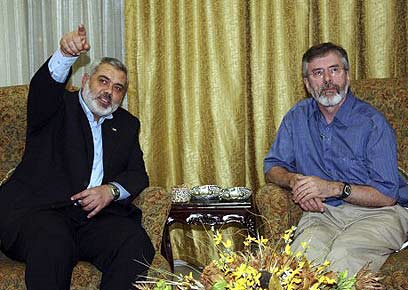
He’s a big man with a warm smile and friendly demeanour who readily shook all our hands and urged us to sit.

Through an interpreter he welcomed Gerry and the rest of us. He spoke of the Irish republican struggle and of the Irish Peace Process. The Prime Minister explained to us the Hamas decision to stand in the elections of 2006, of their success and of the subsequent hostile reaction of Israel, the EU and USA. He told us of the human and economic cost of the Israeli blockade and of the recent air and ground offensive.

Gerry and he spoke about peace and how to achieve it, of the difficulties involved and of the possibilities arising from the appointment of George Mitchell. They spoke about Hamas’s attitude to Israel and the accusation that Hamas was for the destruction of the Israeli state and against peace.

It was a long meeting. Almost an hour and a half. When it was over we were whisked back to our hotel. I used the hotel internet to immediately issue a statement from Gerry explaining that we had met the Hamas leader. In it Gerry said:
“I was pleased to speak directly with Mr Haniyeh. I outlined to him Sinn Féin’s view that there should be a complete cessation of all hostilities and armed actions by all sides.

“I emphasised our opinion that dialogue, including substantive and inclusive negotiations, and a genuine peace process, is the only way forward for Palestinians and Israelis.

“The fact is that the people of Palestine and the people of Israel are destined to live side by side. I believe that most people want a peaceful accommodation.
“Following my meeting with Mr Haniyeh I believe that progress is possible. Mr Haniyeh told me that Hamas wants a peace agreement.


“As I have said consistently: there needs to be a dialogue between the people of Palestine and their leadership and the people of Israel and their leadership. That is what worked in Ireland.

“I believe that there is a duty on the international community to recognise the democratic outcome of the elections in Palestinian Territories. I believe that the people of Palestine and the people of Israel have the right to live free from the fear of threats, with human rights and in dignity and as equals.

“The citizens of Gaza are living in an open-air prison. They are being denied their human and national rights. This has to be rectified.”

The human cost of the siege
The next morning we were up early for an intensive round of further meetings. Local business leaders expressed their anger at the impact of the siege on efforts to stimulate jobs and commerce. The blockade means that no reconstruction of the damaged caused during the Israeli attack has been possible. The business and commercial life of Gaza is being strangled.

Other political meetings took place during the day with representatives from Fatah, the Democratic Front for the Liberation of Palestine, the Popular Front for the Liberation of Palestine and the People’s Party and others.

In the afternoon, we met the Hamas Mayor of Gaza and the City Council, Minister for Health Dr Bassem Na’im, and senior Hamas government officials, the Palestinian Legislative Council, including the Minister for Justice, and we visited Shifa Hospital.

The director of the hospital, which is the largest in the Palestinian Territories, gave us a quick tour and explained some of the grave medical and human problems confronting them. He told us that within minutes of the commencement of the Israeli attack in December around 140 bodies were brought to the front door of the hospital. The medical staff were swamped and there were so many bodies in such desperate condition that initially they couldn’t tell the dead from the severely wounded.

The director pointed to a half-finished building for much-needed intensive care units. It can’t be completed because the Israeli blockade prevents building materials coming into Gaza. During a tour of the hospital we were taken into rooms containing modern radiation machines for treating cancer patients that are lying idle because the Israeli authorities will not allow spare parts in.

In one particular hospital room we were introduced to a father and mother watching over their 13-year-old daughter who lay curled up on a hospital bed and will die shortly because she could not receive the treatment she needed for bone cancer. It was a heart-breaking experience.

The political meetings and interviews with the media continued again up to very late that evening. It was our last night in Gaza.

The next morning we were at Erez at 8am waiting to cross back into Israel. This time, however, the Israeli authorities would not allow us to use the cars. We had to walk through ‘No Man’s Land’ with our bags and baggage to the terminal.

There, a remote voice instructed us through air-locks and computer-controlled doors. Bags on one track to be scanned and X-rayed, and us into an enclosed contraption that whizzed around us to presumably detect anything illegal.

A long, deliberately dragged-out process that took two-and-a-half hours. A new experience for us but for the dozen or so NGO workers who travel back and forward every few weeks it was an old routine experienced many times. Some told us that they can wait up to 12 hours! I felt sorry for them having to put up with that nonsense but they took it in their stride – fair play to them.

Behind us, one and a half million people remained locked up in their huge out-door prison. The Israeli blockade allows a drip-feed of food and other resources. It’s all minimal. Barely enough to keep the place ticking over. Barely enough to feed people. The electricity network often fails. The sewage system is inadequate and is frequently on the point of collapse. People – children mostly – are dying because of inadequate medical resources or access to outside care. No substantial repairs have been carried out on damaged property, no homes being built, no factories being repaired and there is no sign of any relaxation of the siege.

It is a depressing, disastrous human crisis that looks set to get worse unless wiser heads prevail.

The Israelis seem determined to sustain the siege while the international community appears equally determined to stand by and allow this inhumanity to continue. It’s a disgrace but, worse, without a solution soon, it is a powder keg waiting to explode.

With 60 per cent of the population of Gaza under 18, the consequences for the region of this huge youth population isolated and trapped in a small confined geographical area and within a cycle of violence and poverty is obvious – or at least it should be. As Gerry warned:

“If allowed to fester and grow, in 20 years the world will look back at this time and remember Hamas as the moderates!”

And then we were out and on our way to Ramallah in the West Bank where we had a meeting with the Palestinian Authority.

We were now back on republican time – that is, we were running late. Later on still, we travelled to Bethlehem where Dr As’ad Abdul Rahman of the PLO Executive walked us around Al Duhasha, a Palestinian refugee camp established 60 years ago.

In the evening, we held discussions with members of the PLO Executive, including Rafiq Husseini, President Mahmoud Abbas’s Chief of Staff, and again Dr As’ad Abdul Rahman of the PLO Executive.

Back in Ireland
Saturday morning before Easter Sunday and we were on our way home.
Speaking on his return to Ireland, Gerry summarised the four days and outlined our next steps.

“I left the Middle East even more convinced that a process of dialogue between all of the participants is essential for progress.

“Democratic mandates must be respected and in any negotiation process there must be clear objectives set, within a fixed timeframe, if there is to be confidence that any new round of negotiations will be real.

“I believe that only a two-state solution which provides for the security and prosperity of Palestinians and Israelis, as well as national rights for Palestinians, can deliver a durable peace settlement.

“The response of the international community over many years to the political and humanitarian crisis in this region, and in particular to the plight of the Palestinian people, has been shameful.

“With George Mitchell travelling to the Middle East early next week there is a new opportunity opening up which must be grasped. But as that new initiative takes shape, the siege of Gaza should end immediately, all armed actions should cease and the reconstruction of Gaza, which the Israeli blockade is preventing, should begin.
“I intend to submit a report of my visit to Senator Mitchell and to the Irish, British and US governments and others with an interest in and influence on the situation there.

“Eleven years ago on Friday, the Good Friday Agreement was achieved. Many of those I have spoken to in recent days in the Middle East clearly take hope from that achievement. With political will it can be done in the Middle East also.”

14 April 2009

Adams Gaza Report To George Mitchell

Adams to send out Middle East report

SINN FÉIN president Gerry Adams is to send a report on his Middle East trip this week to US peace envoy George Mitchell.

He plans to send copies of the report to Minister for Foreign Affairs Micheál Martin, the Israeli government and to Sinn Féin’s contacts internationally.

Speaking by telephone from Jerusalem, Mr Adams expressed shock at the “wholesale destruction” he saw during his visit to the Gaza Strip this week.

He also visited the Israeli town of Sderot whose residents have been the subject of rocket attack from Palestinian militants.

“These are just ordinary working people and we said that to Hamas,” Mr Adams said. However, he added that there was “no proportionality” between Israel’s attack on Gaza and the rockets fired into Sderot.

Mr Adams said he had to walk through the Eretz checkpoint on his way out of Gaza, and that it took 2½ half hours to get through. He also visited a Palestinian refugee camp at Bethlehem, and met Israeli non-governmental organisations in Jerusalem.

On the destruction in Gaza, he said: “You actually have to be there to see how bad it is.”

He also met an official from the Israeli foreign ministry, but no government politicians.

Describing Gaza as “an open-air prison”, the Sinn Féin leader highlighted the poor state of medical facilities in particular. source

13 April 2009

Talking Sense About Israel & Palestine

Sinn Fein President Gerry Adams had a recent visit to Gaza. This after attempts by Israel to ban him for entering Gaza. But suddenly, the next day he was inside Gaza, carrying out his business as intended. The sudden reversal by Israel was quite telling. Moreover, Adams met with all parties (except Israel as they once again refused) and he will be issuing a report to George Mitchell, among many others, after his meetings inside Gaza. Adams brings some cred to this situation. Well respected within Palestine, Adams has also held meetings with Palestinian leaders on the conflict back in 2006. Clearly Adams is assisting the Obama administration in their search for Middle East peace, this is a good thing, so long as the US government play fair and do not "use" Adams and Sinn Fein for ulterior motives and I am quite certain Adams will be watching for any signs of that.

On a personal note, I believe Hamas can learn much from Adams on how to move forward politically and hold political negotiations with Israel. Should there be a genuine attempt at REAL peace negotiations by the Obama admin, then Hamas will need to move from a "war scenario" to a "political negotiations" scenario. This is where they can learn much from Adams and other Sinn fein negotiators. It's a delicate balance moving from one to the other and you have to move your base along with you as well. Case in point=within only a few years Sinn Fein has become the 2nd largest party in the North and are also gaining ground in the Free State South.

Adams has an interesting perspective in an interview with the Jpost. I have published excepts below which are interesting to take note of. I am still very much a skeptic regarding the Obama Administration to really play fairly with Palestine. Having said that I watched the inter workings of the Irish Peace Process take shape and I must say I do recognise parallels. Some of this gives me pause to think that possibly Obama may "do the business" and establish a Palestinian state, but what "kind" of state is another matter and will require much inspection by the world community.

Anyway, note Adams handling of the grilling he received by the Jpost (a Zionist pro-Israeli paper) this is political mastery at it's finest IMHO Article below:

Northern Ireland politician Gerry Adams, who met Wednesday with Hamas Prime Minister Ismail Haniyeh, dismissed Israeli criticism that these meetings give Hamas legitimacy, telling The Jerusalem Post in an interview Friday that "the voters give Hamas their legitimacy."
(Point-Score-Adams)

"If I may say so, when people are challenged to go to the ballot box, and they win, you cannot say to the electorate, hard luck, we don't like who you voted for," Adams said by phone as he was traveling from Bethlehem to Jerusalem.
(round #2 below)

Reminded that the Nazis took power through the ballot box, Adams, head of the Irish Republican Army-linked Sinn Fein party, responded, "Let's not get into the Nazis. Let's talk about Sinn Fein, a party that is generally accepted as having played a positive role in the [Northern Ireland] peace process.
(Again, point-score-Adams)

"I visited the Holocaust museum in Washington. I deeply appreciate the huge suffering the Jewish people have endured. I have huge affinity with what people came through in the Holocaust and the concentration camps, and anti-Semitism and all of that. And I stand firmly and absolutely against all of that.

"But there was a time when there was no dialogue in Ireland, and there was conflict," he said. "Once we opened up the process to allow dialogue, and made it inclusive, we started a very difficult process that challenged everyone. It challenged Sinn Fein, it challenged the British government, challenged the unionists."

Adams said there was a "certainty" about war "that people can be comfortable in, because you don't have to take chances."
(Once again, Point-Score-Adams, he called Israel out, Israel does not want to be challenged, hence they make attempts to "deflect" to other issues, or cry anti-semitism or "holocaust" Adams did not fall for that tactic)

But, he said, "you can take chances and ensure that no person has to be killed, or live in fear or be imprisoned and subjected to all the people of Israel and the people of Palestine have been subjected to. We took the chance in Ireland. It wasn't easy, but the rewards more than vindicate and validate the risks that were taken."

Asked if he thought the two conflicts - Northern Ireland and Israel - were comparable, he said they were not, but there were parallels.
"I do think there are broad principles like political will that can be applied to the conflict resolution process," he said.

When reminded that the IRA never set out to destroy Britain, as Hamas has declared it wanted to do to Israel, Adams said that the Irish example has shown that "once people have a peaceful way to make progress, sensible thinking people will not use armed actions. So it's not a matter of who wants to destroy what, people should be able to resolve differences peacefully and through dialogue."
(They thought they could catch him out on that one, wrong-o Israel. He handles that one like a professional political master. You see Adams and Sinn Fein have had a great many years dealing with the British govt, the US govt and the Irish govt, plus their own people, they have seen all this type of attempted manipulation before. It would take more than an Israeli paper to beat him on this tactic)

Adams, who left the region early Saturday morning, said he believed Hamas when they said they "are not al-Qaida, they are not the Taliban, they want peace with their Israeli neighbors." Adams said that Hamas "told me they wanted a peace settlement, that they are prepared to accept a two-state solution."

Asked if he believed them, he said, "It's not whether I believe them. The fact is they are duly elected representatives of their people, let's test them, if need be. Let's enter into talks, let's have proper talks, let's have inclusive talks. Let's develop a project that ends aggression of all kinds. My position, and the Sinn Fein position, is that all aggressive actions should cease. There should be no armed actions by any of the Palestinian factions, or by the Israeli state." "The people of Palestine and people of Israel are destined to live together," he said. "It is an accident of birth where you are born. And people should live together respecting each other's rights.
(Pay close attention to the trap they tried on him below, and take a look at how he handled this, it's magic, pure political magic!)

Asked how he would recommend Israel respond to constant rocket fire on a large swath of its territory, he said, "I'm against the rockets, and I made that clear, that's why I went to the places I went to. And I also made clear wherever I spoke that I'm against that. But the solution lies in recognizing that the people of Palestinian have the right to a state that is viable and sustainable, and recognizing that the security of Israel is interlocked into the rights of dignity and security of the people of the Palestinians territories."
(Game-Point-Adams)

09 April 2009

Mitchell & Obama~ Knew Adams Would Meet Hamas


Ha Ha Ha, the two beards meet:) LOL

It appears as if our people will be helping as contacts within the peace process perhaps. This is why Israel had to ultimately let Adams into Gaza after threatening not to. It seems that George Mitchell (and Obama) was well aware of Adams planned visit and more over, Adams himself will be briefing Mitchell on his meetings when he leaves Gaza.

GAZA CITY, Gaza Strip (AP) - The leader of Irish Republican Army-linked Sinn Fein party met with the head of the internationally shunned Hamas government during a two-day visit to Gaza and said he plans to brief President Obama's special Mideast envoy about his contacts.

Gerry Adams, a key player in Northern Ireland's peace process, met with Hamas Prime Minister Ismail Haniyeh late Wednesday and planned more talks with officials of the Islamic militant group Thursday.

Haniyeh's meeting with Adams, at an undisclosed location in Gaza City, was not announced ahead of time. TV footage from a local news outlet showed Adams sitting in an armchair next to Haniyeh

"We want to help. We support the Palestinian people," Adams said.

Adams told The Associated Press in an interview Wednesday he said he met Obama's special Mideast envoy George Mitchell in Washington last month and told him of his plan to visit Gaza. He said he plans to "brief the Irish government, friends in the U.S., others I deal with internationally, and that would include Sen. Mitchell."

Mitchell did not meet with Hamas officials during a visit to the region several months ago. Mitchell and Adams have known each other since the former U.S. senator helped broker a Northern Ireland peace deal in the 1990s.

Sinn Fein is a political party linked to the Irish Republican Army _ a group that, like Hamas, was labeled terrorist because of violent tactics used to battle Britain. But unlike Hamas, Sinn Fein engaged in negotiations that transformed it into a legitimate political player, recognized by Britain and local foes.

Haniyeh welcomed Adams as "a man of rich political experience who faced circumstances in Ireland similar to what we face in Gaza."

Hamas, which seized control of Gaza by force in 2007, is widely shunned by the West. Some European politicians have called for dialogue with Hamas, but few Western politicians have met with Hamas officials. Hamas is considered a terrorist group by Israel, the U.S. and the European Union.

A willingness to talk and compromise produced success in the case of Northern Ireland. Following the IRA's cease-fire in 1997, Sinn Fein joined in negotiations with other parties and the British and Irish governments, and is now the second-largest political party in Northern Ireland.

He also said Gaza's border crossings _ kept tightly closed by Israel and Egypt since the Hamas takeover _ should be opened. source

Report From Gaza~

Here is a report from An Phoblacht, Sinn Fein's weekly Political paper:

A frontline report from Palestine's Gaza Strip

White Phosphorous bombs – a legacy of suffering

DURING Israel’s three-week long offensive on Gaza launched on 27 December, the Israeli Army used internationally-banned weapons according to foreign military and medical experts. American-made white phosphorus shells were used in populated areas across the Gaza Strip, home to about 1.5 million people.

Dr Nafez Abu Shaban, head of the Burns Unit at Shifa Hospital, Gaza’s largest medical centre, has treated dozens of patients who suffered severe burns. He is keeping a piece of phosphorus covered under sand in a jar to prevent it from being exposed to oxygen.

“Of course, at the beginning of the war, we thought they were normal burns,” Dr Shaban says, “but then patients came back to the hospital suffering from severe pain, and some patients even died. Patients who suffer from 15 per cent surface burns should not die, so we started to ask why.

“Some of the doctors who came to Gaza to help us seemed to have experienced these burns as a result of the use of white phosphorous bombs.”

FAMILY KILLED

More than three months have passed since Israel ended its war but it has left legacies of suffering and sad memories. Life has returned to normality for many people but Sabah Abu Halima, who was burnt from head to toe and lost her husband and four children, is still in pain. She has weekly physiotherapy sessions at Shifa Hospital.

We visited her at her house in the northern Gaza Strip town of Seyafa, about 1km from the Strip’s northern border with Israel.

She showed us around her house which was burned as a result of white phosphorous shell that fell on her family’s 16 members through the roof “We had a happy home,” she tells us. “I lived in this house in security with my husband and children. I was the happiest person in the world but all of that changed when, on 4 January, the Israeli Army entered our village and fired two phosphorous shells that penetrated our roof and burnt us while we were having our lunch. The fire was like lava. My family were burnt and their bodies turned to crisps.”

Phosphorous shells penetrated our roof and burnt us while we were having our lunch. The fire was like lava. My family were burnt and their bodies turned to crisps
– Mother Sabah Abu Halima, who lost her husband and four children in an Israeli attack. The mournful mother, who is still unable to walk or talk properly, said the house was completely engulfed in flames but she found a photo of her youngest daughter, Shahad, who was only 15 months old. I asked her to comment on the writing which was left on the wall of her bedroom that reads: “From the Israeli Defence Force, we are sorry!”

She says:

“I demand the whole world and international human rights organisations to sue the killers of my family. They killed so many innocent people who tried to rescue us.
“What was the guilt of my children and my baby Shahad? Their sorry will not bring back my family. I’m still physiologically and mentally in pain. I can’t even pick up a cup of tea now. My life will never be the same.” She has tears in her eyes.
Some Israeli soldiers have admitted they killed civilians under the so-called rules of engagement. Acts of vandalism, violating medical ethics, using civilians as human shields and indiscriminate killing was obvious through the use of lethal force.

INTERNATIONAL COMMUNITY

The use of internationally-banned weapons by Israeli forces will leave many with long-term illnesses and it is believed that the area will remain contaminated, putting locals at risk of contracting sickness.

Dr Shaban wants the international community to put pressure on Israel to tell the truth.

“We need to know to know if uranium was used. Were others banned weapons used? We need to know the long-term implications. Will these weapons cause cancer?
“It’s the duty of the international community to investigate this matter. Now we hear many people are still afraid to eat vegetables planted in areas where phosphorous was used because it might be contaminated with radiation.”

The war has changed the lives of many people like Sabah and left a story in every house in besieged Gaza. More than 1,400 Palestinians were killed, most of them civilians, including 313 children. About 5,500 were injured.

Sabah’s tragedy is one of many documented by many international lawyers and fact-finding missions but whether those behind these crimes will be brought to justice remains to be seen.

Gerry Adams Meets With Ismail Haniya~Talks of Peace


Adams said Gaza is an "Open Air Prison" how true!

Adams meets Hamas PM in Gaza

Sinn Féin leader Gerry Adams says he believes there can be progress in the Middle East after talking to Gaza's Hamas prime minister.

Mr Adams had an hour long meeting with Ismail Haniya on Wednesday night.

Mr Adams said he was encouraged by the dialogue. "Mr Haniya told me that Hamas wants a peace agreement," he said.

The meeting came at the end of a day in which Mr Adams met with civic, political and business leaders in Gaza.

He also toured parts of northern Gaza devastated by the Israeli operation in the Palestinian territory in January.

He said: "I welcome the opportunity to engage with so many people.

"I was pleased to speak directly with Mr Haniya. I outlined to him Sinn Féin's view that there should be a complete cessation of all hostilities and armed actions by all sides.

"The fact is that the people of Palestine and the people of Israel are destined to live side by side. I believe that most people want a peaceful accommodation.

"Following my meeting with Mr Haniya I believe that progress is possible.

"As I have said consistently there needs to be a dialogue between the people of Palestine and their leadership and the people of Israel and their leadership.

"That is what worked in Ireland."

On Tuesday, Mr Adams visited Sderot and Kfar Aza - a town and Kibbutz - in southern Israel that have been the targets for rocket attacks from Gaza.

However, before he set off for the Middle East Israeli officials said they would not meet him because he would not rule out meeting Palestinian militants.

They had threatened not to allow him to enter Gaza.

He said he regretted the Israeli government's refusal to meet him VIDEO LINK HERE.

08 April 2009

UPDATE~Gerry Adams IN GAZA NOW

Adams urges talks on Gaza visit

Sinn Féin leader Gerry Adams urged Israelis and Palestinians to hold direct talks as he visited Gaza on Wednesday.

Israeli officials are unhappy about Mr Adams' visit as he has not ruled out meeting officials from Hamas.

Hamas, which rules Gaza, is listed as a terrorist organization by Israel, the US and EU.

Mr Adams toured parts of northern Gaza devastated by war that Israel waged in the Palestinian territory this year.

He said: "The obligation is that what happened here doesn't happen again,"
"And that means there needs to be negotiations and that means that the leadership in Israel and the leadership in the Palestinian territories need to be involved in a direct dialogue.

"The international community, particularly the US, need to be actively encouraging that."

Mr Adams met John Ging, director of operations in Gaza for the UN Refugee and Works Agency, which supports Palestinian refugees.

He also visited an ice cream factory which was destroyed during the war and spoke with its owner.

Before Mr Adams set off for the Middle East Israeli officials said they would not meet him because he would not rule out meeting Palestinian militants.

They had threatened not to allow him to enter Gaza.

The Sinn Féin leader, who last visited the Middle East in 2006, said he regretted the Israeli government's refusal to meet him.

"As the leader of a party which was censored and demonised and whose members were killed, I see dialogue between all sides as key to building a successful peace process," he said.

"So I will meet with all sides and urge all sides to end all armed actions and to engage in meaningful dialogue.

"I believe there should be a complete cessation of all hostilities and freedom of movement for everyone."

Mr Adams said there were "similarities" between the Northern Ireland peace process and the Middle East, but "there are also significant differences".

"But it is clear that finding solutions will require leadership on both sides, and a willingness to take risks, initiatives, and compromise," he said.

07 April 2009

Racist Israel Bans Gerry Adams from Entering Gaza


The leader of the 2nd largest party in the North of Ireland. A man who could be used to help bring about peace. A man who was involved in the Irish peace process and without whom we would not have one. A man who has worked closely with George Mitchell, Bill Clinton, Tony Blair, and Isarel does not want to let him into Gaza. For the background on this read my post HEREWhere they attempted to force Adams into saying he would not meet with HAMAS while in Gaza. newsflash.... Hamas were duly ELECTED in GAZA so they are the Gazan Government.

Israel bars N Ireland leader from Gaza
Northern Ireland political leader Gerry Adams will not be allowed to enter Gaza this week because he planned to meet officials from Hamas, the militant group that rules the territory, an Israeli official said on Tuesday.

Foreign Ministry spokesman Yigal Palmor said Israel "would not help Adams meet with Hamas terror leaders". Hamas is listed as a terror organisation by Israel, the US and EU.

A spokesman for Adams, Ted Howell, said Adams and his delegation planned to visit Gaza on Wednesday. He said, "we will meet with whoever wants to meet us."

Again you should read THIS for the background. Adams wouldn't be threatened, so now he is "banned" by racists and murderers. Can't wait for Israel to be charged with war crimes. Rest assured I will celebrate for a month!

01 April 2009

Despite Israel's Objections~Sinn Fein Will Meet ALL Elected Palestinians

Gerry Adams, President of Sinn Fein is to once again go to Palestine to meet all sides in the conflict, however Israel refuses to meet him once again. Adams went over in 2006 and Israel refused to meet him then as well. Additionally, Sinn Fein has had many productive meetings with the Palestinian leaders both in Palestine and in Ireland. I would like to see Mitchell invite others from Sinn Fein over to possibly help as the Palestinian leaders have much respect for our people and could learn politically from them; however, the US would have to ensure they were not using us, or the Palestinians, for some ulterior motives. Anyway, Adams will be in Palestine next week, and will meet with all Palestinian leaders once again, despite Israel’s nose being out of joint. If interested I managed to locate both a video of Adam’s first trip in 2006 and also a video of Ahmad Yousef (Ismail Haniyeh’s Political Advisor) interview after meeting with Sinn Fein in Ireland. Today's articles below from the Irish Times and Adam's blog:

Adams to meet Hamas despite Israeli objections

Sinn Féin president Gerry Adams confirmed today he will visit the Middle East next week despite Israeli government demands that he does not meet Hamas.

Mr Adams said he refused to give a commitment to avoid representatives from the Palestinian group and, as a result, he regretted that Israeli officials would not now meet him during his trip.

But the Sinn Féin leader said dialogue was vital to securing a peace settlement in the region and he appealed for efforts to secure an agreement that could satisfy both Palestinian and Israeli needs.

Mr Adams visited the region in 2006 and was in both Israel and Ramallah, but this time he will add Gaza to his list of destinations to witness at first hand the damage caused by controversial Israeli attacks launched in response to Palestinian rockets.

"I will meet with senior members of the Palestinian Authority. I again (as in 2006) asked for a meeting with the Israeli government or with government officials. But again this has been refused because I will not give a commitment not to speak with Hamas representatives.

“I very much regret the Israeli government decision.” Mr Adams added: “As the leader of a party which was censored and demonised and whose members were killed, I see dialogue between all sides as key to building a successful peace process.

“So I will meet with all sides and urge all sides to end all armed actions and to engage in meaningful dialogue.

“I believe there should be a complete cessation of all hostilities and freedom of movement for everyone.” Mr Adams said the region faced the challenge of bringing about a settlement on the basis of a two-state solution.

“This requires a sustainable and durable state for the Palestinian people. They share the region with their Israeli neighbours. Without doubt, the security of the people of Israel is linked inextricably to the rights, freedom and prosperity of the people of Palestine.

“But it is clear that finding solutions will require leadership on both sides, and a willingness to take risks, initiatives, and compromise.

“And it will need the international community, and particularly the USA, to play a very positive and active role.”


And here is a bit from Adam’s blog on his up coming trip:


So next week I will again visit Israel and Ramallah. But this time I will also travel into Gaza and Sderot and Ramallah where I will meet with senior members of the Palestinian Authority.

I again asked for a meeting with the Israeli government or with government officials. But again this has been refused because I will not give a commitment not to speak with Hamas representatives.

But it is clear that finding solutions will require leadership on both sides, and a willingness to take risks, initiatives, and compromise.

And it will need the international community, and particularly the USA, to play a very positive and active role. In this respect I welcome the appointment of George Mitchell as US Envoy to the Middle East.

If you want to read about his trip when he returns you can come back here or bookmark his blog HERE


Video of Adam’s 2006 Visit & Ahmad Yousef Interview are below

Ahmad Yousef after meeting with Sinn Fein in Ireland on finding solutions to their conflict:


Adams in 2006 on his visit: